
Use this bonus tax calculator to see how much of a bonus you actually keep. A bonus is taxed as part of your pay, so it is added to your salary and taxed at your highest rate, with National Insurance, student loan and pension taken off too.
Your bonus after tax
- Income Tax on bonus
- –
- NI on bonus
- –
- Student loan and pension
- –
- Bonus you keep
- –
- Deducted
- –
In the example, a £5,000 bonus on a £40,000 salary costs £1,000.00 in Income Tax and £400.00 in National Insurance, so you keep £3,600.00.
How to use the bonus tax calculator
- Enter your yearly salary before the bonus.
- Enter the bonus before tax.
- Add your pension percentage if your pension is also taken from bonuses.
- Tick bonus sacrifice to see what happens if you pay the whole bonus into your pension.
How bonuses are taxed in the UK
There is no special bonus tax rate. Your bonus is added to your other pay for the year, so the rate depends on where your total income falls:
- Basic rate (up to £50,270): 20% tax and 8% NI, so you keep about 72%.
- Higher rate (£50,271 to £100,000): 40% tax and 2% NI, so you keep about 58%.
- £100,000 to £125,140: 60% effective tax plus 2% NI, because you lose £1 of Personal Allowance for every £2 earned.
- Additional rate (over £125,140): 45% tax and 2% NI.
A student loan adds 9% on top in each band, and a pension contribution taken from the bonus lowers the tax.
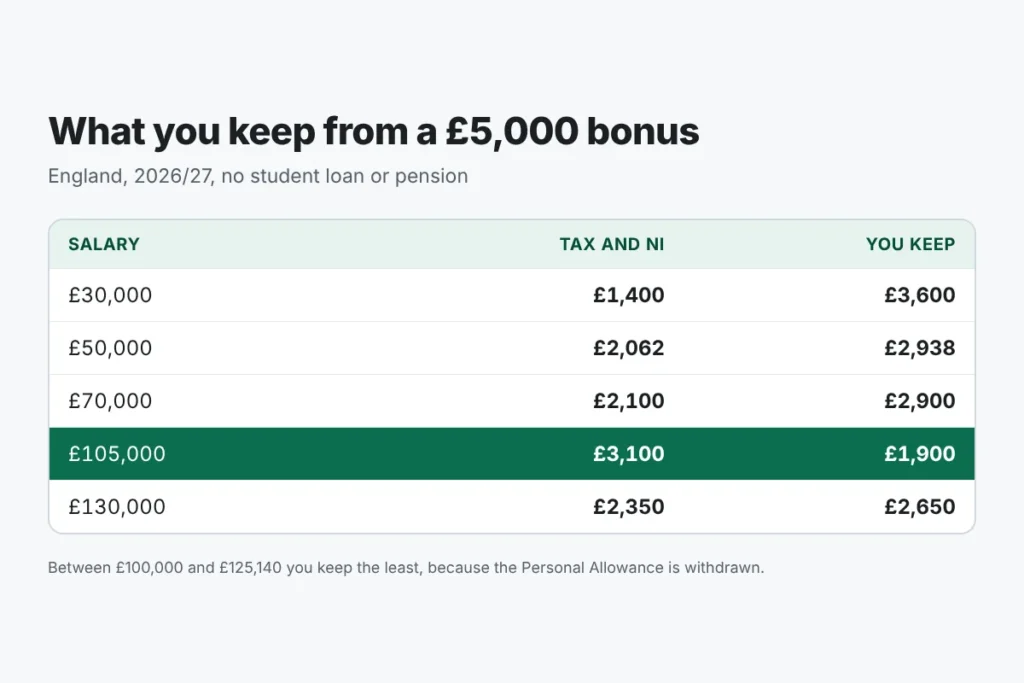
Bonus tax examples
| Salary | Tax on bonus | NI on bonus | You keep | Kept |
|---|---|---|---|---|
| £25,000 | £1,000 | £400 | £3,600 | 72% |
| £40,000 | £1,000 | £400 | £3,600 | 72% |
| £50,000 | £1,946 | £116 | £2,938 | 59% |
| £60,000 | £2,000 | £100 | £2,900 | 58% |
| £98,000 | £2,600 | £100 | £2,300 | 46% |
| £130,000 | £2,250 | £100 | £2,650 | 53% |
The table shows why the bonus tax calculator asks for your salary: the same bonus is worth very different amounts depending on which band it lands in.
Why does my bonus payslip show so much tax?
PAYE works out tax month by month. In the month you get a bonus, your pay looks much higher, so more of it can fall into the higher rate band for that month. If your yearly income stays in the basic rate band, the extra is usually given back automatically over the rest of the tax year. The bonus tax calculator shows the tax over the full year, which is what you really pay.
Bonus tax calculator with a student loan
A student loan takes 9% of the bonus on top of tax and NI. On a £40,000 salary with a Plan 2 loan, you keep £3,150.00 of a £5,000 bonus, rather than £3,600.00. The loan payment still reduces what you owe, so it is not lost, but it does lower the cash you receive.
Bonus sacrifice: paying your bonus into your pension
Many employers let you swap a bonus for an employer pension contribution. You pay no Income Tax or NI on it, and some employers add their NI saving. For someone on £98,000, a £10,000 cash bonus is worth only £4,200 after tax, but the whole £10,000 can go into their pension. It also avoids the 60% tax trap and can help keep Child Benefit, see the child benefit tax calculator.
Related calculators
For your regular pay, use the monthly take home pay calculator. For a permanent rise, try the salary increase calculator.
Frequently asked questions
How much tax will I pay on a £1,000 bonus?
A basic rate taxpayer keeps about £720 (20% tax and 8% NI). A higher rate taxpayer keeps about £580.
Is bonus tax higher than normal tax?
No. It is taxed at the same rates as your salary. It only looks higher because of how PAYE works in the month you are paid.
Can I avoid tax on my bonus?
You can reduce it by paying the bonus into your pension through salary sacrifice, or into a workplace share scheme, if your employer allows it.
Does a bonus count for student loan repayments?
Yes. Plan 1, 2, 4 and 5 loans take 9% of earnings over the threshold, including bonuses, in the pay period you receive it.
About this calculator
This bonus tax calculator uses 2026/27 Income Tax, National Insurance and student loan rates, checked against GOV.UK on 9 November 2026. It works on your yearly income, not a single payslip. Results are estimates.