
This capital gains tax calculator works out the tax when you sell shares, a second home, a buy-to-let or other assets for more than you paid. It takes off your costs, any losses and the £3,000 annual exempt amount, then applies the 18% and 24% rates based on your income.
Your Capital Gains Tax
- Gain
- –
- Taxable gain
- –
- Capital Gains Tax
- –
- Effective rate
- –
| Amount | Rate | Tax |
|---|
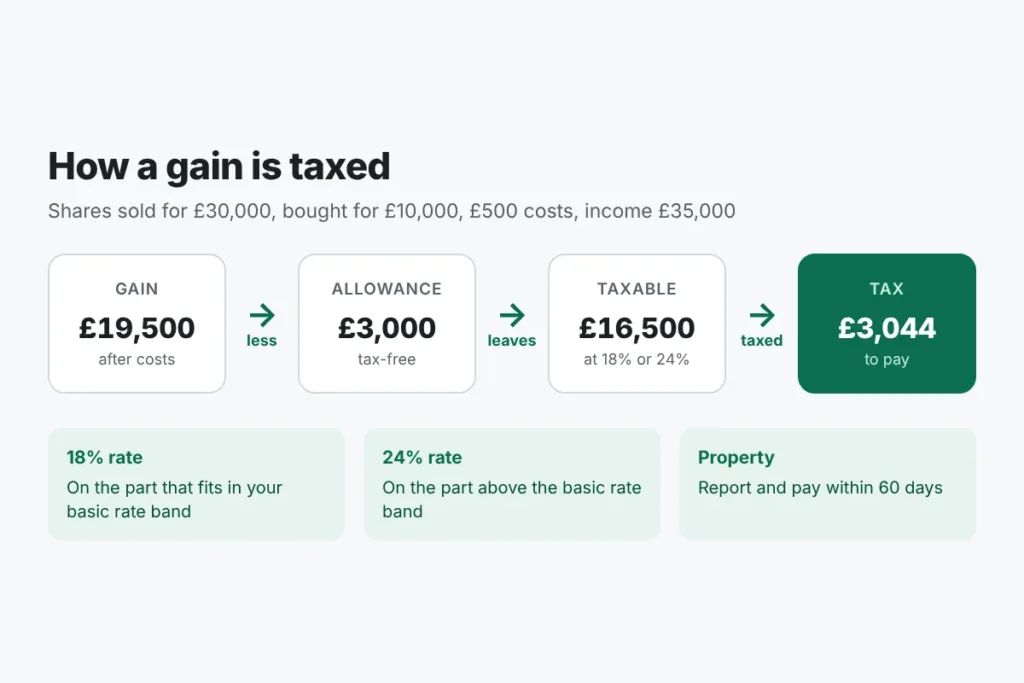
In the example, shares bought for £10,000 are sold for £30,000 with £500 of dealing costs. The gain is £19,500, the taxable gain is £16,500 and, with a £35,000 salary, the Capital Gains Tax is £3,043.80.
How to use the capital gains tax calculator
- Choose the asset type. Residential property must be reported and paid within 60 days.
- Enter the sale price and what you paid. For a gift or inheritance, use the market value when you received it.
- Add allowable costs: stamp duty, legal and estate agent fees, broker fees and improvements (not repairs).
- Enter any losses from the same tax year or earlier years that you reported to HMRC.
- Enter your taxable income. It decides how much of the gain falls in the basic rate band.
Capital Gains Tax rates and allowance
For 2026/27 the annual exempt amount is £3,000 a person. Gains above it are added on top of your income. The part within the basic rate band is taxed at 18% and the rest at 24%. The same rates now apply to property, shares and most other assets. See the GOV.UK Capital Gains Tax rates.
| 2026/27 | |
|---|---|
| Annual exempt amount | £3,000 |
| Rate within the basic rate band | 18% |
| Rate above the basic rate band | 24% |
| Business Asset Disposal Relief rate | 18% |
| Reporting deadline for UK homes | 60 days from completion |
Capital gains tax calculator UK examples
The tax depends heavily on your income. Here is the same capital gains tax calculator result for a £20,000 gain at different incomes:
| Your taxable income | Tax on a £20,000 gain | Effective rate |
|---|---|---|
| £0 | £3,060 | 15.3% |
| £20,000 | £3,060 | 15.3% |
| £35,000 | £3,164 | 15.8% |
| £45,000 | £3,764 | 18.8% |
| £60,000 | £4,080 | 20.4% |
Selling property: what you can deduct
If you sell a buy-to-let or second home, you can take off the purchase costs (stamp duty, solicitor, survey), selling costs (estate agent, solicitor) and the cost of improvements such as an extension. Repairs and mortgage interest are not deductible from the gain.
Your main home is normally free of the tax under Private Residence Relief. If you are a landlord, the rental income tax calculator covers the yearly tax on rent, which is separate.
Ways to reduce Capital Gains Tax
- Use each year’s allowance by spreading sales over more than one tax year.
- Transfer assets to your spouse or civil partner before selling. Transfers between you are tax-free, and you then have two allowances and two sets of bands.
- Claim your losses. Report losses within 4 years so they can be used against future gains.
- Use ISAs and pensions. Gains inside them are tax-free.
- Pay into a pension to extend your basic rate band if you pay by relief at source.
Worked example: selling a buy-to-let
Tom sells a flat for £300,000 that he bought for £200,000. He paid £3,000 in purchase costs, £4,500 in selling fees and £15,000 for a new kitchen extension. His gain is £77,500. With a £40,000 salary, the capital gains tax calculator shows £17,264 to pay within 60 days of completion. Most of the gain is taxed at 24% because only a small part fits in his basic rate band.
Shares, funds and crypto
Shares and funds are the most common use of a capital gains tax calculator, and the cost figure is the hardest part to get right.
For shares and crypto, the cost is worked out using pooling rules, so you use the average cost of the shares in your pool, with special rules for anything bought back within 30 days. If you have made many trades, an accountant or your platform’s tax report can give the cost figure to use in the capital gains tax calculator.
Related tax calculators
For income from shares, use the dividend tax calculator. For interest, try the savings tax calculator. Browse all our UK tax calculators.
Frequently asked questions
How much Capital Gains Tax will I pay on £50,000?
With a £35,000 income and no losses, a £50,000 gain means £10,363.80 of tax. With income above £50,270 it would be £11,280.00.
Do I pay Capital Gains Tax on my home?
Usually not, if it has been your only or main home the whole time you owned it. Part of the gain can be taxed if you let it out, used part only for business, or the grounds are over 5,000 square metres.
When do I pay Capital Gains Tax?
For UK residential property, report and pay within 60 days of completion. For other assets, report through Self Assessment and pay by 31 January after the tax year.
Does Capital Gains Tax affect my income tax band?
Gains are added on top of income to decide the rate, but they do not change the tax on your income or count towards the Personal Allowance taper.
About this calculator
This capital gains tax calculator uses 2026/27 rates checked against GOV.UK on 9 November 2026. It assumes the basic rate band of £37,700 and does not handle trusts, non-residents or holdover relief. Results are estimates; check complex cases with HMRC or an adviser.