
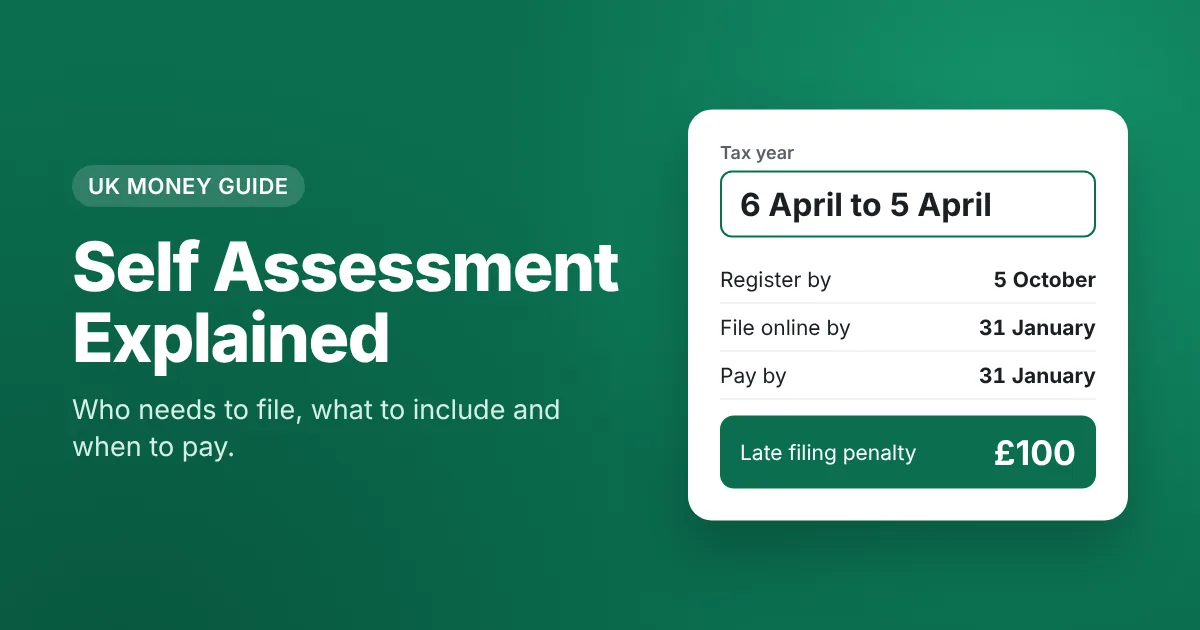
Self Assessment is the system HMRC uses to collect Income Tax from people whose tax is not fully taken through PAYE. Each year you fill in a tax return showing your income, and HMRC works out the tax. This guide explains who needs to do a Self Assessment, what goes on the return and how the tax self assessment process works from start to finish.
At a glance
- You usually need to file if you are self-employed (over £1,000), a landlord, or have untaxed income over £2,500.
- Register by: 5 October after the tax year.
- File online and pay by: 31 January.
- Late filing: £100 penalty straight away.
Do I need to do a Self Assessment?
You usually need to file a Self Assessment tax return for a tax year (6 April to 5 April) if any of these apply (GOV.UK: check if you need to send a tax return):
- You were self-employed as a sole trader and earned more than £1,000.
- You were a partner in a business partnership.
- You had untaxed income over £2,500, such as rent from a property or tips.
- You made capital gains that are taxable.
- You or your partner had income over £60,000 and got Child Benefit, unless you pay the charge through your tax code.
- You had foreign income that needs to be taxed in the UK.
- You had savings or dividend income above your allowances that HMRC cannot collect through your tax code.
Since 2023/24, employees taxed only through PAYE no longer need to file just because their income is over £150,000.

What goes on a Self Assessment tax return?
The main return (SA100) covers employment, pensions, savings, dividends and Gift Aid. Extra pages cover self-employment (SA103), partnerships (SA104), property (SA105), foreign income (SA106) and capital gains (SA108). Online, HMRC shows only the sections you need.
How Self Assessment tax is worked out
HMRC adds up all your income, takes off your allowances and reliefs, and charges Income Tax and, for the self-employed, Class 4 National Insurance. Tax already paid through PAYE is deducted. To estimate the bill on sole trader profits, use our self employed tax calculator; for rent, the rental income tax calculator.
Key Self Assessment dates
| Date | What happens |
|---|---|
| 5 April | Tax year ends |
| 5 October | Deadline to register if you are new to Self Assessment |
| 31 October | Paper returns due |
| 31 January | Online returns due and tax to pay (plus first payment on account) |
| 31 July | Second payment on account |
See our full guide to Self Assessment deadlines and how to pay, and how to register for Self Assessment if you are new.
Making Tax Digital for Income Tax
From 6 April 2026, sole traders and landlords with qualifying income over £50,000 must keep digital records and send quarterly updates using compatible software, then a final declaration instead of the usual return. The threshold falls to £30,000 from April 2027 and £20,000 from April 2028 (GOV.UK: Making Tax Digital).
Self Assessment tips
- Keep records of income and expenses for at least 5 years after the 31 January deadline.
- File early: you still pay on 31 January, but you know the bill sooner.
- Set money aside every month in a separate account.
- Claim all allowable expenses and reliefs, such as pension contributions and Gift Aid.
Frequently asked questions
What is Self Assessment?
A system for reporting income that has not been taxed at source, through an annual tax return to HMRC.
Do I need to do a Self Assessment if I only have a job?
Usually not. PAYE collects the tax, unless you have other income or the High Income Child Benefit Charge to pay.
Can I do Self Assessment myself?
Yes. Most people file online through their HMRC account. An accountant can help with complex affairs.
What happens if I miss the deadline?
There is a £100 penalty straight away, even if no tax is due, with more penalties and interest after 3, 6 and 12 months.