
This redundancy tax calculator works out your statutory redundancy pay and the tax on your whole package. It applies the £30,000 tax-free limit, taxes notice pay and holiday pay as normal earnings, and shows what you take home.
Your redundancy pay
- Statutory redundancy
- –
- Weeks of pay
- –
- Tax-free
- –
- Tax and NI
- –
- Package after tax
- –
| Amount | Tax and NI |
|---|
In the example, a 45-year-old with 10 years’ service on £700 a week gets 12 weeks’ pay, or £8,400 of statutory redundancy pay. It is all under £30,000, so no tax is due on it.
How to use the redundancy tax calculator
- Enter your age on the date your job ends and your full years of service.
- Enter your weekly pay before tax. For statutory pay it is capped at £751.
- Add any enhanced redundancy pay your employer offers on top.
- Add notice pay and holiday pay, which are taxed like normal pay.
- Enter other pay this tax year, so the calculator can find your tax rate.
Statutory redundancy pay
You qualify after 2 years with your employer. For each full year of service, up to 20 years, you get (GOV.UK redundancy pay):
- half a week’s pay for each year you were under 22
- one week’s pay for each year you were 22 to 40
- one and a half weeks’ pay for each year you were 41 or older
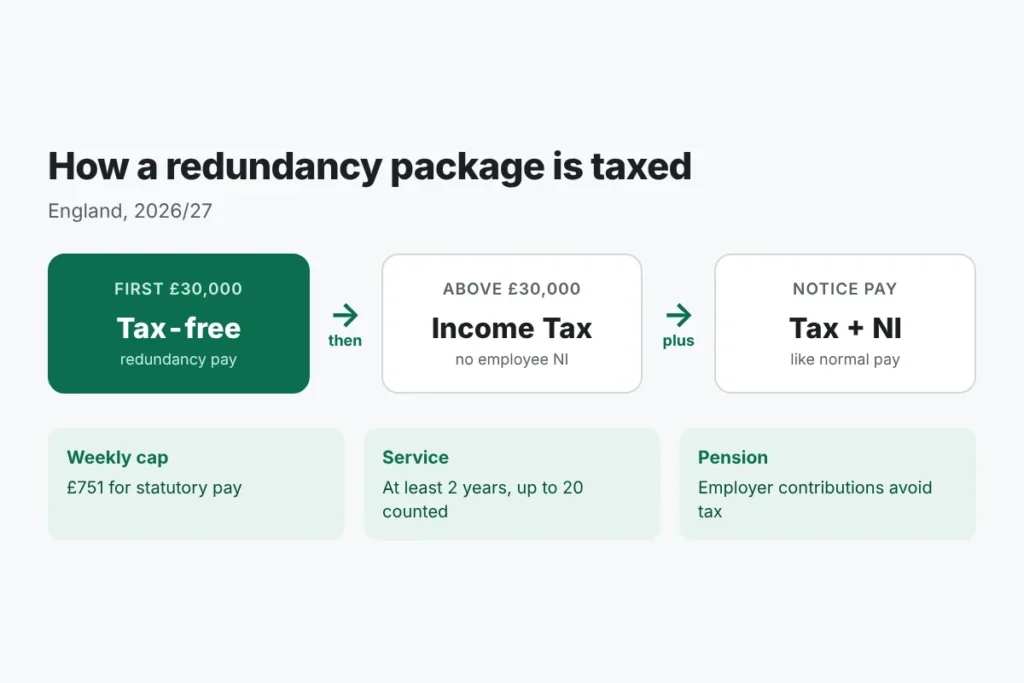
Weekly pay is capped at £751 for redundancies from 6 April 2026, so the most you can get is £22,530.
Statutory redundancy pay examples
| Age | Years | Weekly pay | Weeks | Statutory pay |
|---|---|---|---|---|
| 25 | 4 | £500 | 3.5 | £1,750 |
| 35 | 10 | £650 | 10 | £6,500 |
| 45 | 10 | £700 | 12 | £8,400 |
| 50 | 20 | £900 | 24.5 | £18,400 |
| 60 | 25 | £1,000 | 29.5 | £22,154 |
How redundancy pay is taxed
| Payment | Income Tax | Employee NI |
|---|---|---|
| Statutory and enhanced redundancy pay up to £30,000 | No | No |
| Redundancy pay over £30,000 | Yes | No |
| Notice pay (including pay in lieu of notice) | Yes | Yes |
| Holiday pay owed | Yes | Yes |
| Contractual bonuses and commission | Yes | Yes |
Redundancy pay above £30,000 is taxed at your normal rates, and your employer pays Class 1A NI on it. Because it is added to your income for the year, a large package can push you into the higher rate band.
Redundancy tax calculator example with a large package
Sam is 50, has 20 years’ service and earns £900 a week. Statutory pay is 24.5 weeks capped at £751, which is £18,399.50, and the employer adds £20,000 of enhanced pay. The package of £38,399.50 has £30,000 tax-free and £8,399.50 taxable. With £40,000 of salary already this year and £3,000 of notice pay, the redundancy tax calculator shows most of the taxable part falls in the higher rate band.
Reducing tax on a large package
Ask whether you can pay part of the taxable amount into your pension. Employer pension contributions are free of tax and NI, within your annual allowance. Leaving early in the tax year may also mean less other income that year.
Related calculators
Plan your budget with the monthly take home pay calculator. If you overpaid tax after leaving, the tax rebate calculator can check it.
Frequently asked questions
Is redundancy pay tax-free?
The first £30,000 of redundancy pay is free of tax and NI. Notice pay and holiday pay are always taxed.
How much redundancy pay will I get after 10 years?
Between 5 and 15 weeks’ pay, depending on your age during those years. The redundancy tax calculator works out your exact number.
Does redundancy pay affect benefits?
Redundancy pay counts as savings for Universal Credit once received. Savings over £6,000 reduce your award and over £16,000 stop it.
When should I get my redundancy pay?
Usually with your final pay. If your employer does not pay, you can apply to the Redundancy Payments Service.
About this calculator
This redundancy tax calculator uses the £751 weekly cap from 6 April 2026 and 2026/27 tax rates, checked against GOV.UK on 9 November 2026. Different rules apply in Northern Ireland. Results are estimates.