
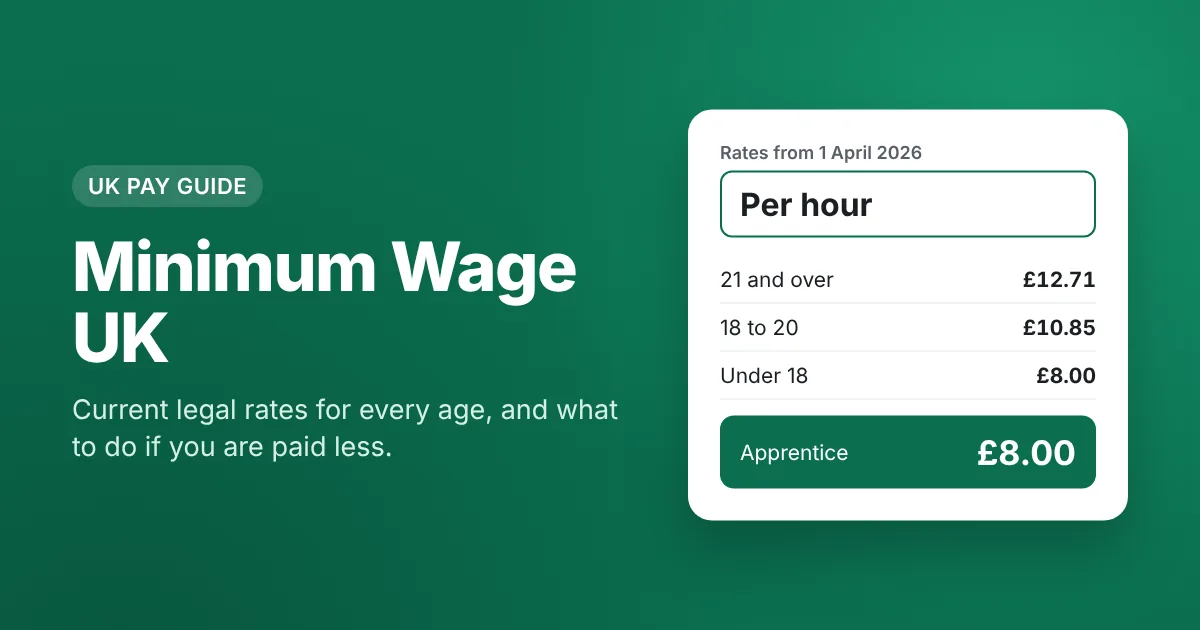
The minimum wage UK employers must pay depends on your age and whether you are an apprentice. Since 1 April 2026, workers aged 21 and over must get at least £12.71 an hour, known as the National Living Wage. This guide covers every rate, who is entitled to it, what counts as pay and what to do if you are paid less.
At a glance
- 21 and over: £12.71 an hour (National Living Wage) from 1 April 2026.
- 18 to 20: £10.85. Under 18 and apprentices: £8.00.
- Next rise: £13.21 for 21 and over from 1 April 2027.
- Underpaid? Your employer must pay back arrears; contact Acas or HMRC.
Current minimum wage UK rates
| Age group | Hourly rate | Full-time yearly (37.5 hours) |
|---|---|---|
| 21 and over (National Living Wage) | £12.71 | £24,784.50 |
| 18 to 20 | £10.85 | £21,157.50 |
| Under 18 (above school leaving age) | £8.00 | £15,600.00 |
| Apprentice | £8.00 | £15,600.00 |
| Accommodation offset | £11.10 a day | – |
To turn any of these rates into weekly, monthly or yearly pay for your own hours, use our minimum wage salary calculator.

National Minimum Wage, National Living Wage and the real Living Wage
Three similar names cause a lot of confusion. Only the first two are legal requirements:
- National Living Wage: the legal minimum for workers aged 21 and over, currently £12.71 an hour.
- National Minimum Wage: the legal minimum for younger workers and apprentices, with rates set by age.
- Real Living Wage: a voluntary rate set by the Living Wage Foundation based on living costs. It is £14.10 an hour across the UK and £15.45 in London. Accredited employers must pay it by 1 May 2027.
When people ask “what is minimum wage UK?”, they usually mean the National Living Wage, because most workers are 21 or over. The UK minimum wage for younger workers is lower and depends on age.
Next increase in April
Rates change every year on 1 April. The government has already confirmed the rates from 1 April 2027:
| Age group | Now | From 1 April 2027 | Rise per hour |
|---|---|---|---|
| 21 and over | £12.71 | £13.21 | £0.50 |
| 18 to 20 | £10.85 | £11.27 | £0.42 |
| Under 18 | £8.00 | £8.31 | £0.31 |
| Apprentice | £8.00 | £8.31 | £0.31 |
For a full-time worker aged 21 or over on 37.5 hours, the April 2027 rise is worth £975.00 a year before tax. Rates are recommended each autumn by the Low Pay Commission, an independent body, and then confirmed by the government. See our guide to the next minimum wage rise for what it means for your pay.
Who is entitled to the minimum wage
You are entitled to the UK minimum wage if you are a worker and above school leaving age. That includes:
- full-time and part-time employees, including those on zero-hours contracts
- agency workers and casual or seasonal workers
- apprentices (at the apprentice rate or the rate for their age)
- workers on probation, trainees and home workers
You are not entitled if you are genuinely self-employed, a company director, a volunteer, or below school leaving age. Members of the armed forces, students on work experience that is part of their course, and family members who live at home and work in the family business are also excluded, according to Acas.
For the rate that applies at each age, including what happens on your birthday, see minimum wage by age.
What counts as pay
Employers must pay at least the legal rate on average for the hours worked in each pay reference period, which is usually a week or a month.
| Counts as pay | Does not count |
|---|---|
| Basic pay | Tips, gratuities and service charges |
| Bonuses and commission paid in the period | Overtime or shift premiums above your basic rate |
| Accommodation, up to £11.10 a day | Expenses such as travel, tools or uniform |
| Pay for training and travel between jobs | Benefits in kind, such as meals or a car |
Deductions for things like uniforms, tools or meals must not take your pay for the period below the legal rate. Neither can payments you are asked to make to your employer for work-related items.
Time that must be paid
Your employer must pay the minimum wage for every hour you work, which includes:
- time spent travelling between jobs or clients during the working day
- training you are required to do
- time when you are at work and required to be available, even if there is little to do
- time spent waiting to start work if your employer requires it
Your normal commute to and from work does not count. Rules for sleep-in shifts and on-call time are more detailed, so check with Acas if they apply to you.
How to check you are paid the minimum wage
- Find your gross pay for one pay period on your payslip, before tax.
- Take off anything that does not count, such as tips or overtime premiums.
- Divide by the hours you actually worked in that period, including unpaid extra time.
- Compare the result with the rate for your age.
Our hourly wage calculator does steps 3 and 4 for you, and flags if your rate is below the legal minimum.
What to do if you are paid less than the minimum wage
- Talk to your employer. Mistakes do happen, especially after a birthday or a rate change in April.
- Get free advice from Acas on 0300 123 1100 or at acas.org.uk.
- Complain to HMRC. HMRC enforces the law. You can make a complaint through GOV.UK pay and work rights, and you can do it anonymously.
Employers who underpay must pay back the arrears, worked out at today’s rates if those are higher. They can also be fined up to 200% of what they owe and publicly named by the government.
Common pay mistakes to look out for
HMRC regularly finds the same errors when it checks employers. Look out for these on your own payslip:
- not moving a worker to the higher rate after their 18th or 21st birthday, or after the first year of an apprenticeship
- not paying the new rates from 1 April
- charging for uniforms, tools or training in a way that takes pay below the minimum wage
- not paying for time spent on compulsory training, security checks or handovers
- salaried staff working extra unpaid hours, so their pay per hour falls below the legal minimum
- salary sacrifice schemes that reduce pay below the minimum wage
Employers must keep records that prove they paid the right rate, and HMRC can ask to see them. If you think one of these applies to you, gather your payslips and a note of the hours you worked before you raise it.
Minimum wage UK: the same rate everywhere
The legal rate is the same in England, Scotland, Wales and Northern Ireland, and the same in cities and rural areas. There is no separate legal rate for London. See our guides to the minimum wage in London and the minimum wage in Scotland for how local voluntary rates compare.
Minimum wage tools and guides
- GuideMinimum Wage by Age: Rates for 16, 17, 18, 19, 20 and 21+The legal hourly rate for every age from 16 to 21+, and when your pay goes up.
- GuideMinimum Wage in London: Legal Rate vs London Living WageThe legal minimum in London, the voluntary London Living Wage, and what each pays a year.
- GuideMinimum Wage in Scotland: Current Rates and the Real Living WageThe legal minimum wage in Scotland, how it compares with the real Living Wage, and Scottish tax on low pay.
- GuideApprentice Minimum Wage: Rates, Rules and ExamplesThe legal minimum for apprentices, who gets it and when your pay must rise.
- GuideNational Minimum Wage Increase: New Rates From April 2027The next minimum wage rise, what it means per week and year, and for employers.
- CalculatorMinimum Wage Salary CalculatorWeekly, monthly and yearly pay at the minimum wage for any age and number of hours.
Frequently asked questions
What is minimum wage UK for over 21s?
It is £12.71 an hour from 1 April 2026, rising to £13.21 on 1 April 2027.
Is the national minimum wage the same as the National Living Wage?
Both are legal minimums. The National Living Wage is the name for the rate paid to workers aged 21 and over, and the National Minimum Wage covers younger workers and apprentices.
How much is minimum wage a year full time?
At £12.71 an hour, a 37.5-hour week pays £24,784.50 a year and a 40-hour week pays £26,436.80, before tax.
Can my employer pay me less during a trial period?
No. Probation and trial shifts that are genuine work must be paid at least the legal rate for your age.
Do tips count towards the minimum wage?
No. Tips are extra and must be passed to workers in full, and they cannot be used to make up your basic pay.
Rates checked against GOV.UK on 5 November 2026. We update this guide every April and whenever new rates are announced.