
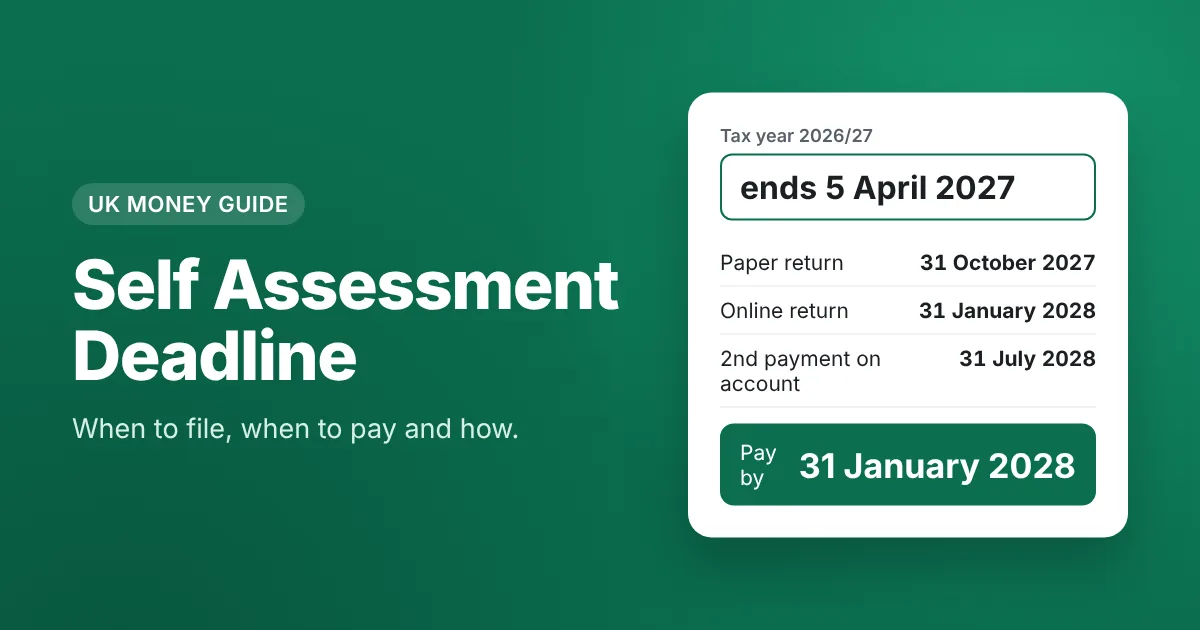
The main Self Assessment deadline is 31 January: that is when your online tax return is due and when you must pay any tax owed for the previous tax year. There are other dates too, and missing them leads to penalties. This guide covers every deadline, payments on account and how to pay Self Assessment tax.
At a glance
- 31 January: online return and tax due.
- 31 October: paper return due.
- 31 July: second payment on account.
- Pay with: your UTR followed by K as the reference.
Self Assessment deadlines
| Deadline | What is due |
|---|---|
| 5 October 2027 | Register if you need to file for 2026/27 for the first time |
| 31 October 2027 | Paper tax return for 2026/27 |
| 30 December 2027 | Online return, if you want tax under £3,000 collected through your tax code |
| 31 January 2028 | Online return for 2026/27, balancing payment and first payment on account for 2027/28 |
| 31 July 2028 | Second payment on account for 2027/28 |

Penalties for missing the deadline
- 1 day late: £100 fixed penalty, even if there is no tax to pay.
- 3 months late: £10 a day, up to £900.
- 6 months late: £300 or 5% of the tax due, whichever is higher.
- 12 months late: another £300 or 5%, or more in serious cases.
- Late payment: interest from the due date, plus penalties at 30 days, 6 months and 12 months.
If you have a reasonable excuse, such as serious illness, you can appeal a penalty.
Payments on account
If your last Self Assessment bill was over £1,000 and less than 80% of your tax was collected at source, HMRC asks for two advance payments towards next year, each half of this year’s bill (GOV.UK: payments on account). They are due on 31 January and 31 July.
In your first year this can mean a big January bill: the whole of last year’s tax plus half again. If you expect lower income, you can ask HMRC to reduce your payments on account. Our self employed tax calculator shows the likely amount in its note.
How to pay Self Assessment tax
You can pay Self Assessment tax in several ways (GOV.UK: pay your Self Assessment tax bill):
- Online or telephone banking (Faster Payments) to HMRC’s account, using your 11-character payment reference (your UTR followed by K).
- Debit card or corporate credit card online (personal credit cards are not accepted).
- Through the HMRC app.
- Direct Debit, set up at least 5 working days before the deadline, or a budget payment plan to pay in advance.
- Through your tax code, if you owe less than £3,000 and file online by 30 December.
Can’t pay on time?
If you cannot pay in full, set up a Time to Pay arrangement online for debts up to £30,000, as long as your return is filed. Paying in instalments avoids late payment penalties, though interest still applies. To plan next year’s bill, try the self employed tax calculator and read our Self Assessment guide.
Frequently asked questions
When is Self Assessment due?
Online returns and payment are due by 31 January after the end of the tax year. Paper returns are due by 31 October.
Is payment on account compulsory for Self Assessment?
Yes, if your bill is over £1,000 and less than 80% of your tax was taken at source. You can ask to reduce it if your income has fallen.
What reference do I use to pay Self Assessment?
Your 10-digit UTR followed by the letter K.
What happens if 31 January falls on a weekend?
The deadline does not move, so pay early. Faster Payments usually arrive the same or next day.